
Before the article: what happened in Geneva
On Tuesday 6 October, at Building Bridges, we introduced the Swiss Information Barometer, a national survey conducted with gfs.bern among 2,000 residents and close to 1,000 organisations. Its question fits on one line: which information does Switzerland decide on?
The first reading takes place on 3 December 2026 in Geneva. The national result follows in January 2027 in Davos, with InTent.
The panel “Information Integrity: The Missing Infrastructure of Prosperity”, moderated by Elsa Obergfell with Sacha Meuter, Andrew Robotham, Frédéric Hoffmann and Isabelle Chappuis, is available as a public replay. The next day, the “Good Pensions” session carried the conversation to pension funds.
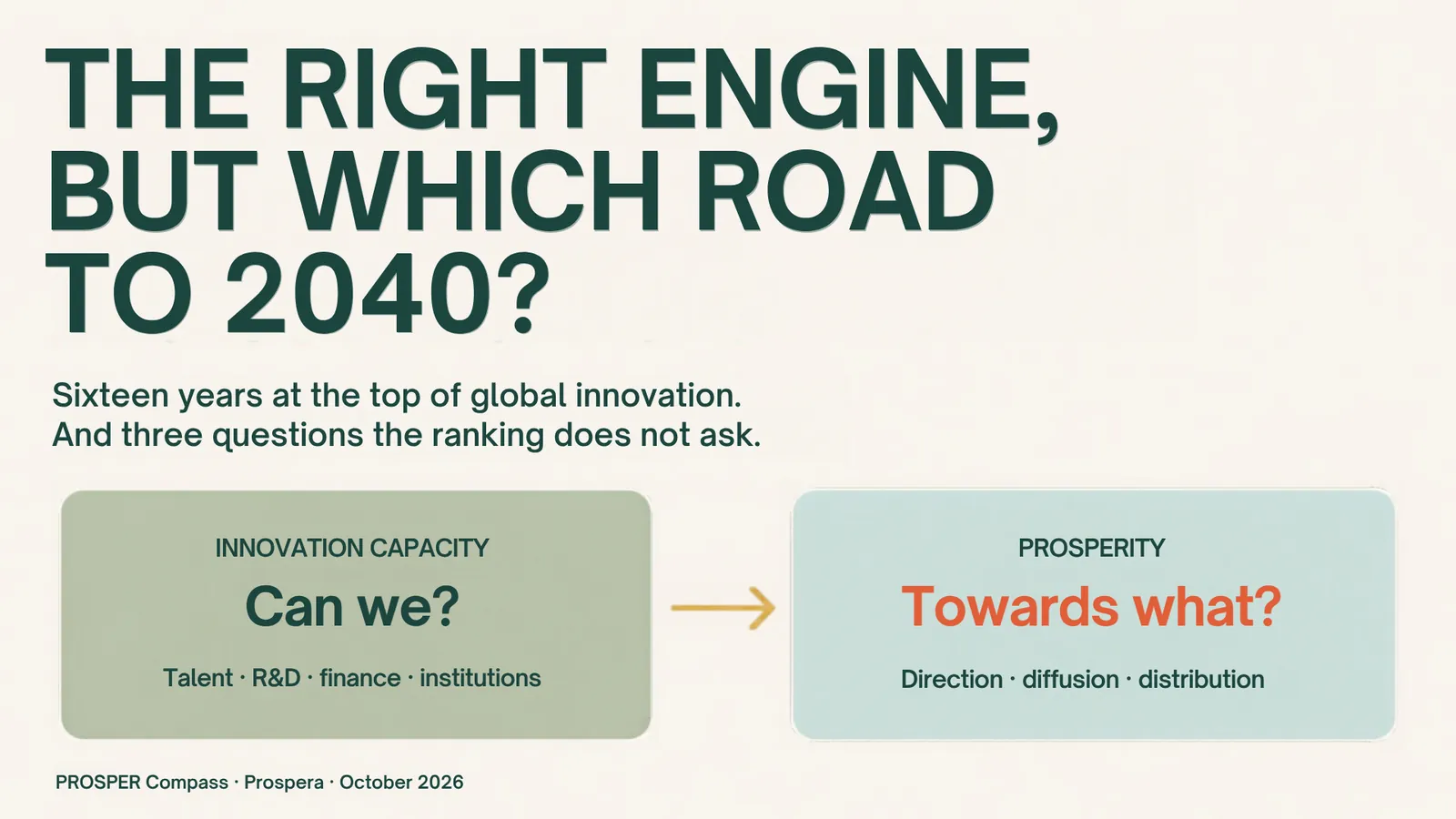
The text below first appeared on LinkedIn on 4 October. It asks the question that ran through both days: a country can have the best engine in the world without ever really choosing its road.
The article
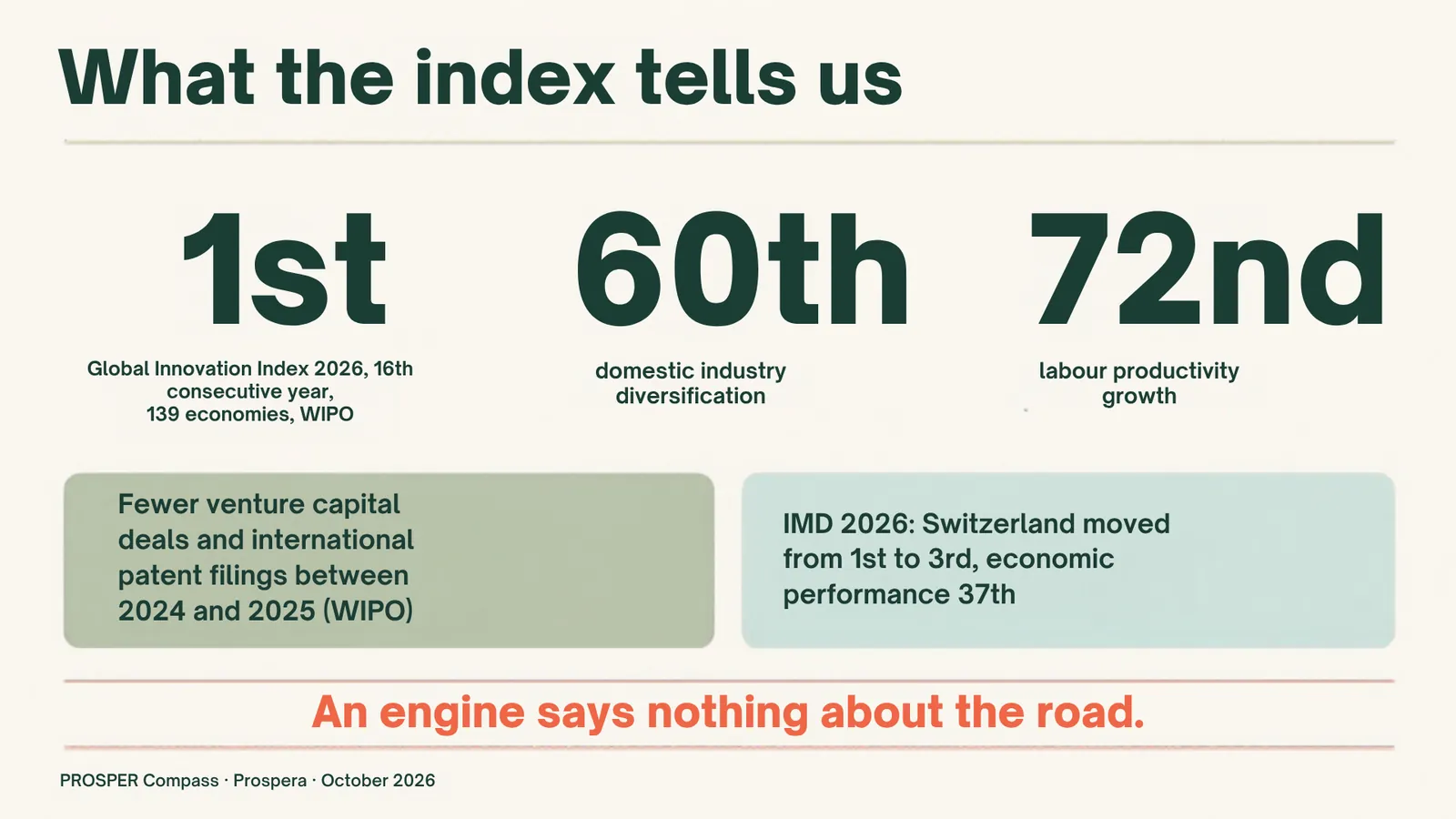
For a week now the same chart keeps coming back in my feed. One line stays at the top: Switzerland, first in WIPO’s Global Innovation Index for the sixteenth year running, out of 139 economies. I am genuinely glad about it. Researchers, companies, universities and the institutions that connect them built this result, year after year.
But an engine says nothing about the road.
Read the Swiss profile to the end. First for innovation outputs, second for intellectual-property receipts as a share of trade. Then, further down the table, 60th for domestic-industry diversification and 72nd for labour-productivity growth, with fewer venture-capital deals and fewer international patent filings between 2024 and 2025. In June, the IMD World Competitiveness Ranking moved Switzerland from first to third. Government efficiency and infrastructure held up. Economic performance fell 24 places to 37th, largely because of direct-investment flows.
I am not trying to play down the first place. I want to say what an innovation index measures, and what it leaves out. It counts inputs and outputs. It does not say what innovation is for, whom it reaches, or who pays for it. Those are three different questions. I call them direction, diffusion, distribution.
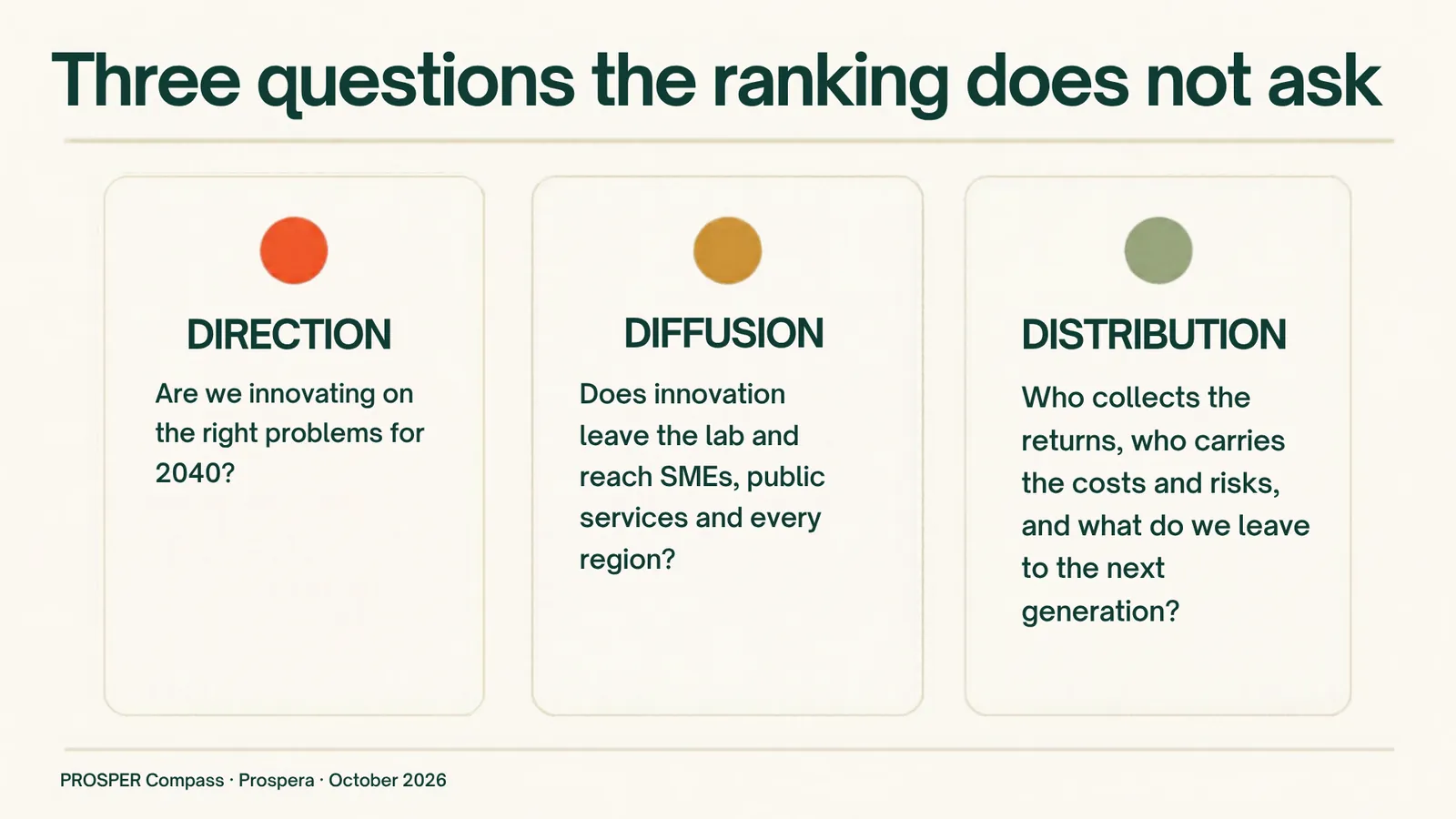
Direction: are we innovating on the right problems?
For more than a decade, innovation research has separated rate from direction. You can produce more R&D, more patents and more startups without ever answering a simple question: to solve what? For Switzerland, the challenges of 2040 are no mystery: growing old and being cared for, closing material loops, securing energy, holding steady when something breaks.
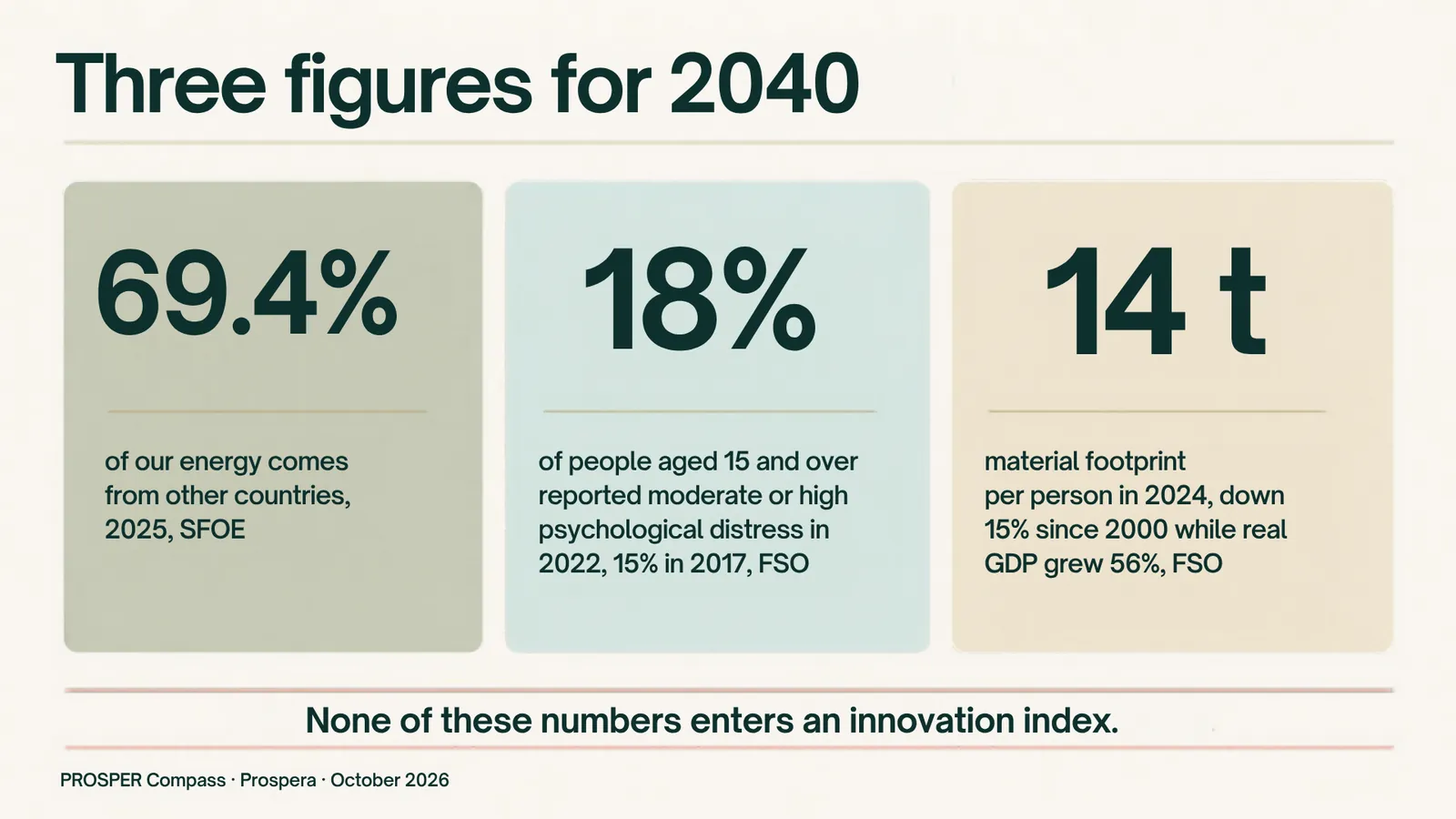
Three figures are enough to see where it pinches. In 2025, Switzerland depended on other countries for 69.4% of its energy. In 2022, 18% of people aged 15 and over reported moderate or high psychological distress, up from 15% five years earlier. Our material footprint fell by 15% between 2000 and 2024 while real GDP grew by 56%, which is genuinely good news, but it still stands at 14 tonnes per person. None of these numbers enters an innovation index. Yet they tell us what our capacity should be for.
Diffusion: does innovation leave the lab?
Leading at the frontier guarantees nothing for the rest of the economy. For several years the OECD has documented a widening productivity gap between the most advanced firms and everyone else. The Swiss profile offers an illustration: world-class outputs next to stagnant productivity and a narrow industrial base. The question I care about is very concrete: how long does a good idea take to travel from a laboratory to an SME’s workshop, to a public-service counter, to a valley far from the big centres?
Distribution: who gains, who pays?
In the United States, Philippe Aghion and his co-authors have shown that innovation can concentrate income at the very top, while innovation by new entrants goes hand in hand with more social mobility. Switzerland is not the United States. But the question applies here too: with each wave of innovation, who collects the returns, who carries the costs and risks, and what do we leave to neighbouring regions or to the next generation? An innovation index cannot answer that. It was never built to.
One condition: the information we decide with
Nobody chooses a direction in a vacuum. Public authorities, companies, investors and citizens need credible evidence to tell real progress from mere visibility. Yet in 2025, 58% of the Swiss population said they had seen content online that seemed false or doubtful. In 2026, 42% of online news users said they trusted most news most of the time, four points fewer than a year earlier.
When information is fragmented or manipulated, the risk is simple: money goes to the wrong place and weak solutions gain legitimacy. That is why the Swiss Information Barometer exists. If prosperity depends on collective choices, we need to understand the conditions under which people, organisations and institutions make them.
Reading capacity and outcomes side by side
I am not arguing for one more league table. Rankings serve reputation, comparison and attraction, and that is fine. They simply do not say whether innovation is turning into prosperity that lasts.
The PROSPER Compass, which we are developing with our partners, is our attempt at an answer. It looks at seven dimensions of prosperity at once and refuses to blend them into a single score, because a very good result on one does not make up for a failure on another. The GII sits inside it, as one signal among others. For any strategy, public policy or investment, the Compass asks the same questions every time: what gets stronger, what gets weaker, who gains, and which costs are pushed elsewhere or later.
It is version 1.6. It is imperfect, and that is exactly why we are publishing it: so that people challenge it and improve it with us.
The road
Switzerland has the engine. The next decade will depend on the road it chooses, on the quality of the information that informs that choice, and on how widely the benefits travel.
Capacity is not direction. Direction is something you choose.
To keep going
If you lead an organisation: explore the PROSPER Compass, version 1.6, and test it on your own strategy: impact.swiss/prosper
If you work on information, research or public policy: contribute to the Swiss Information Barometer’s expert module (contact: B Lab Switzerland) and follow the first reading on 3 December 2026 in Geneva.
If you simply want to talk it through: join us on 29 October 2026 in Geneva (Rethinking Prosperity 2040) or on 18 March 2027 in Bern for the Swiss Impact Forum.
Replay of the 6 October session: https://www.youtube.com/watch?v=kOhE5TQQB94
Original article (LinkedIn, 4 October 2026): https://www.linkedin.com/pulse/right-engine-which-road-2040-jonathan-normand-rykdc/
Sources and further reading
- WIPO, Global Innovation Index 2026: https://www.wipo.int/web-publications/global-innovation-index-2026/en/gii-2026-results.html
- WIPO, Switzerland economy profile, GII 2026 (PDF): https://www.wipo.int/edocs/gii-ranking/2026/ch.pdf
- IMD World Competitiveness Ranking 2026, press release of 18 June 2026: https://www.imd.org/wp-content/uploads/2026/06/Embargoed-Press-Release-2026-IMD-World-Competitiveness-Ranking.pdf
- OECD, The Best versus the Rest: https://doi.org/10.1787/63629cc9-en
- Aghion, P. et al. (2019), Innovation and Top Income Inequality, Review of Economic Studies: https://doi.org/10.1093/restud/rdy027
- Reuters Institute, Digital News Report 2026, Switzerland: https://reutersinstitute.politics.ox.ac.uk/digital-news-report/2026/switzerland
- Federal Statistical Office, household internet use in 2025, press release of 5 December 2025 (French version with the 58% figure): https://www.bfs.admin.ch/bfs/en/home.assetdetail.36304418.html
- Swiss Federal Office of Energy, Overall Energy Statistics 2025: https://pubdb.bfe.admin.ch/de/publication/download/12682
- Federal Statistical Office, Swiss Health Survey 2022, press release of 3 November 2023: https://www.bfs.admin.ch/asset/fr/28625366
- Federal Statistical Office, material flows: https://www.bfs.admin.ch/bfs/fr/home/statistiques/espace-environnement/comptabilite-environnementale/flux-matieres.html

