
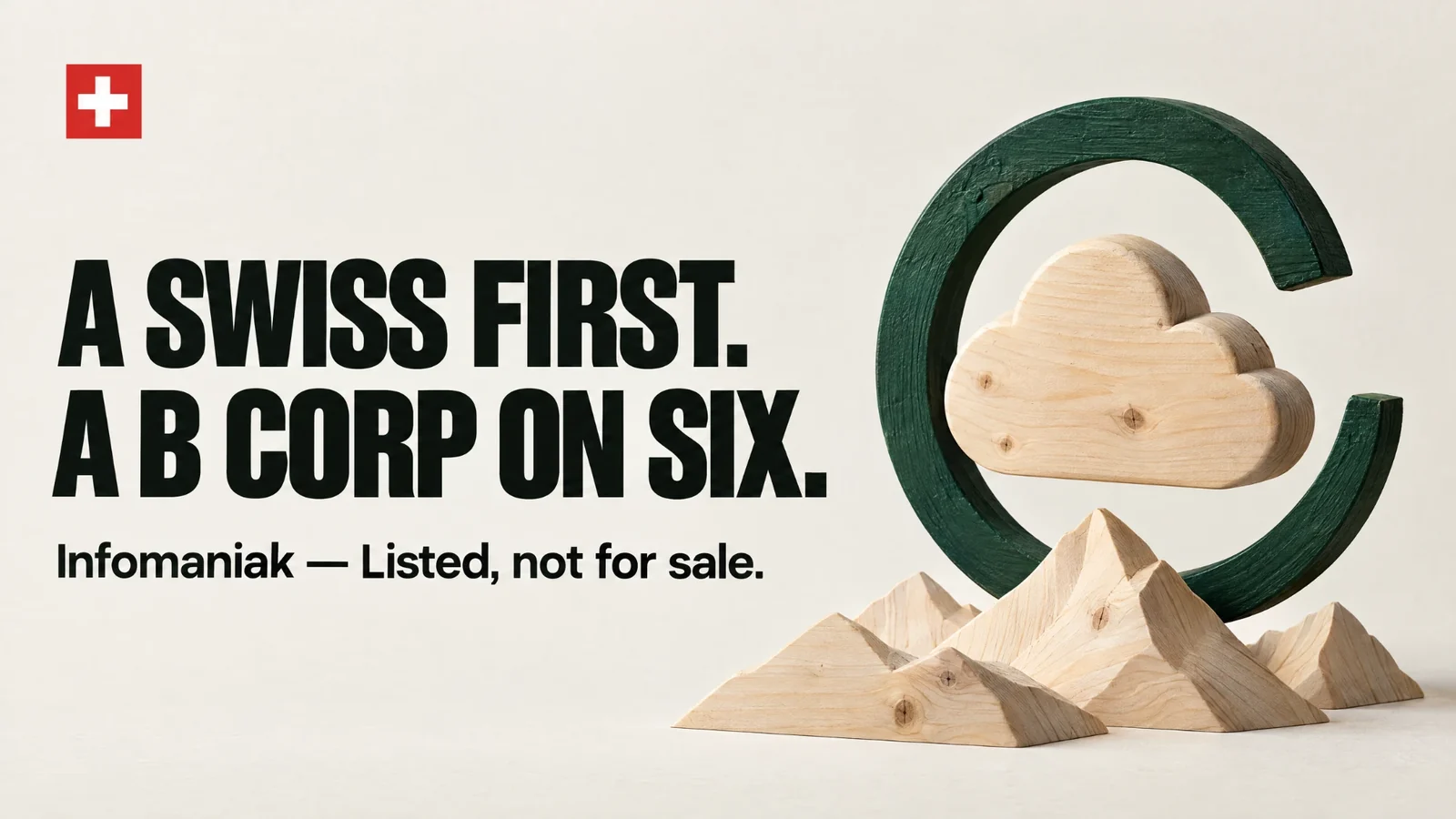
On 1 October 2026, Infomaniak shares began trading on SIX Swiss Exchange under the ticker INFO. The move challenges a familiar story, in which going public marks the moment a company’s founding values start to be diluted. Infomaniak built its structure so that the expectations of new shareholders cannot change its mission. We think other Swiss companies could take inspiration from it, which is why we believe this model deserves a detailed review.
Infomaniak in a few lines
For readers who don’t know it yet, Infomaniak was founded in Geneva in 1994. The company designs and runs its own data centres and develops its own software. It hosts websites and domain names, provides public cloud infrastructure, and offers a full collaborative suite (email, file storage, chat, video calls, an AI assistant) designed as a sovereign alternative to the large US suites. More than 300,000 paying customers in over 190 countries trust it with their data, which is hosted exclusively in Switzerland, with no advertising and no resale. The company employs more than 330 people.
In other words, Infomaniak plays on the same field as the global tech giants, at a very different scale. Every small business and every municipality that entrusts its email, data and website to Infomaniak deserves to know who controls it.
Open the capital, hold the course
The structure has two layers. The first dates from 13 May 2026: founder Boris Siegenthaler and the 36 employee shareholders decided unanimously to transfer the majority of voting rights to the Infomaniak Foundation, a Swiss public-benefit foundation supervised by the Geneva cantonal authority and comprising two independent members on its Board of Trustees. The Foundation now holds 63.3% of the voting rights for 14.7% of the capital, through A shares, known as voting shares. These shares are unlisted and cannot be freely transferred. It takes no operational decisions, but it guards a charter of nine principles, from digital sovereignty to local roots, by way of privacy and environmental responsibility. The Foundation can strengthen this mission, never weaken it.
The second layer is the listing itself. Announced on 29 July 2026, the reverse takeover with Perrot Duval Holding SA, listed since 1905, was approved by the general meeting on 24 September. The listed company is now called Infomaniak SA. Only its B shares trade on the exchange; the A shares, which carry enhanced voting rights, stay with the Foundation. Investors buy a share of the value created but not the power to change its mission.
Put simply, no one can take over Infomaniak without the Foundation’s consent. The Foundation holds the key, and is itself bound by its statutes, under the watch of the canton.
“Investors buy a share of the value created but not the power to change its mission.”
The steward-ownership model
This kind of structure is called steward ownership. It rests on two principles. The first is self-governance: control of the company stays with people connected to its mission, and cannot be sold or inherited like another asset. The second is purpose orientation: profits serve the company’s purpose first.
Its application is not new and has already proven itself abroad. In Germany, Bosch and Zeiss have operated for decades under the control of foundations. In Denmark, so has Novo Nordisk, whilst being listed on the stock exchange. In 2022, Yvon Chouinard transferred Patagonia’s voting rights to a trust and its capital to an environmental organisation: “Earth is now our only shareholder.” Patagonia nevertheless stayed private, having judged the stock market incompatible with its mission.
Switzerland also knows this model from the inside, including within our own community. Eldora, a catering company in French-speaking Switzerland and a Certified B Corp, is wholly owned by the DSR Foundation through its holding company.
Infomaniak applies the first principle in full: control is separated from value and entrusted to a foundation. On the second, it offers a version adapted to public markets, opening economic value to investors while its charter favours reinvesting profits in research and infrastructure. The Foundation may also receive up to 5% of annual profit for its public-benefit purposes. Infomaniak brings two new things to steward ownership. As a listed company, it must publish its results and major decisions under strict rules. And its impact is checked by independent auditors as part of the B Corp certification.
A Swiss first
Until now, no company listed on SIX was also a Certified B Corp. One certified Swiss company belongs to a listed group, and one formerly listed company certified after delisting, but the listed entity itself had never held the certification. Infomaniak, certified since 2025, is therefore the first company listed on the Swiss stock exchange to be a Certified B Corp in its own right.
It is also among the first companies worldwide certified under the new B Corp standards, published in April 2025. The single overall score, where a strength could offset a weakness, has been replaced. Companies must now meet minimum requirements across seven impact topics, with the number of requirements varying by company size and sector. The new standards also introduce progress milestones with additional requirements after three and five years. In addition, compliance is no longer verified by B Lab but by independent third-party audit bodies. These new standards therefore measure not a statement of intent but verified, transparent impact and a focus on continuous improvement. Infomaniak’s new structure fits this aim by creating a governance system in which a change of shareholder cannot call these commitments into question.
“Digital sovereignty cannot be decreed. It lives in organisations whose structure guarantees they will not change course at the first takeover.”
Beyond Infomaniak, a question for the country
This listing comes as Switzerland debates its digital dependence, and as many organisations wonder what may happen to data entrusted to foreign providers. The question is a practical one: where is my data, under which law, and who will decide about it tomorrow? The federal popular initiative “For Switzerland’s digital security”, currently collecting signatures, demands that the country’s essential digital infrastructure remain independent of any influence contrary to its interests. Whatever the outcome of this debate, it forces us to look at who owns, over the long term, the companies our digital sovereignty depends on.
We therefore believe that public authorities should take mission-protecting governance into account, particularly in public procurement, and rely on verified evidence rather than self-declared reports. Infomaniak has shown that this model works, including on the stock exchange. We would like other Swiss companies to follow, and our institutions to help them do so.
Patrick Headon, Certification Lead
Andéol Cadic-Melchior, Certification Coordinator & Analyst

